Prefer to listen? Your phone or computer can read this page aloud. Here's how
January gets all the attention. But for a lot of people, and especially those with ADHD or AuDHD, January is one of the hardest months of the year.
The days are short. The post-Christmas exhaustion is real. And the cultural pressure to reinvent yourself lands at exactly the moment your brain has the least to give.
March is different. And there is a biological reason for that.
Your brain notices the light
The change in daylight from late February into March is not subtle. Sunrise comes earlier. The afternoon light stays longer. And your brain, quite literally, responds.
Your circadian rhythm begins to shift. Melatonin production starts to ease back. Cortisol, which is what helps you wake up, feel alert, and get going, rises at a more useful point in the day.
For people with ADHD or AuDHD, who often have dysregulated sleep-wake cycles and a fraught relationship with mornings, this seasonal shift matters. It is not just that you feel a bit brighter. Your biology is genuinely more cooperative.
The natural calendar was always March
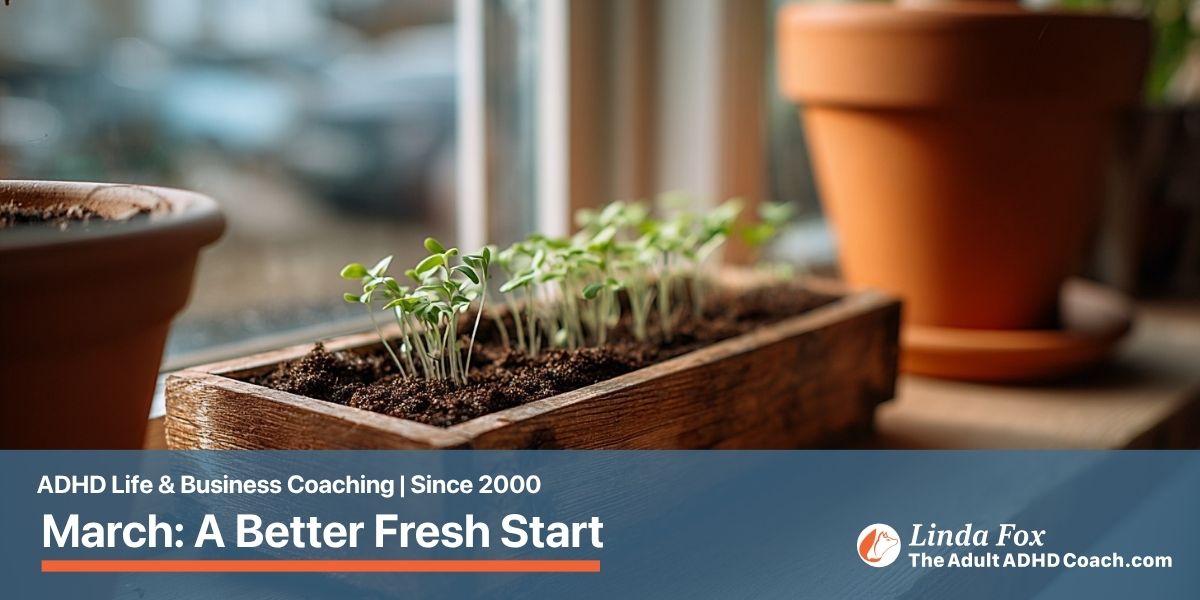
Before the Gregorian calendar was standardised, the new year began in spring. The logic was obvious. Seeds go in the ground. Animals come out of hibernation. Everything around you is starting again.
January the first is an administrative decision. Late March is a biological one.
If your ADHD or AuDHD brain has always felt a bit disconnected from January resolutions, this might be why. You are not bad at fresh starts. You may have been trying to make them at the wrong time of year.
Three ways to use March as a soft restart
These are not resolutions. They are low-resistance experiments. Pick one.
- Shift your morning by fifteen minutes. Use the earlier light to ease your wake-up time. Open a blind, sit by a window, or step outside for a few minutes. You are working with your circadian rhythm, not against it.
- Choose one thing to start, not a list. March energy is real, but ADHD and AuDHD brains can inflate it into a to-do list of fourteen new projects. Pick one thing you have been putting off and give it a single session this week.
- Mark the season, not the calendar. Swap the pressure of New Year, New You for something kinder. Notice what you actually want more of this spring. Not what you think you should want. What you actually want.
That is enough.
If you are looking for small, practical changes that work with your brain rather than against it, my weekly newsletter is a good place to start. Short, practical pieces for adults with ADHD or AuDHD, only when there is something genuinely useful to share. Unsubscribe any time.
Book Your Free Discovery Session →
Related reading
- The Spring Declutter an ADHD Brain Actually Needs
- What the First Three Months Taught You
- The New Tax Year Reset: Simple Money Admin for ADHD Brains
Get the free guide, and join my weekly newsletter
Sign up and I will send you my free guide, 5 ADHD-Friendly Organisation Hacks (and how to make them stick), straight away. You will also join my weekly newsletter with practical strategies for adults with ADHD and AuDHD. Unsubscribe any time.

About Linda Fox
Linda is an ICF-ACC credentialled adult ADHD coach (ADHD Life & Business Coach, CALC), with lived experience of ADHD herself. She has been coaching adults with ADHD since 2000, one of the very first specialist ADHD coaches in the UK.
She works with entrepreneurs, legal and medical professionals, and others navigating demanding careers, helping them build practical strategies that fit how their brain actually works rather than fighting against it.
UK-based, supporting clients with ADHD and AuDHD worldwide on Zoom.