Prefer to listen? Your phone or computer can read this page aloud. Here's how
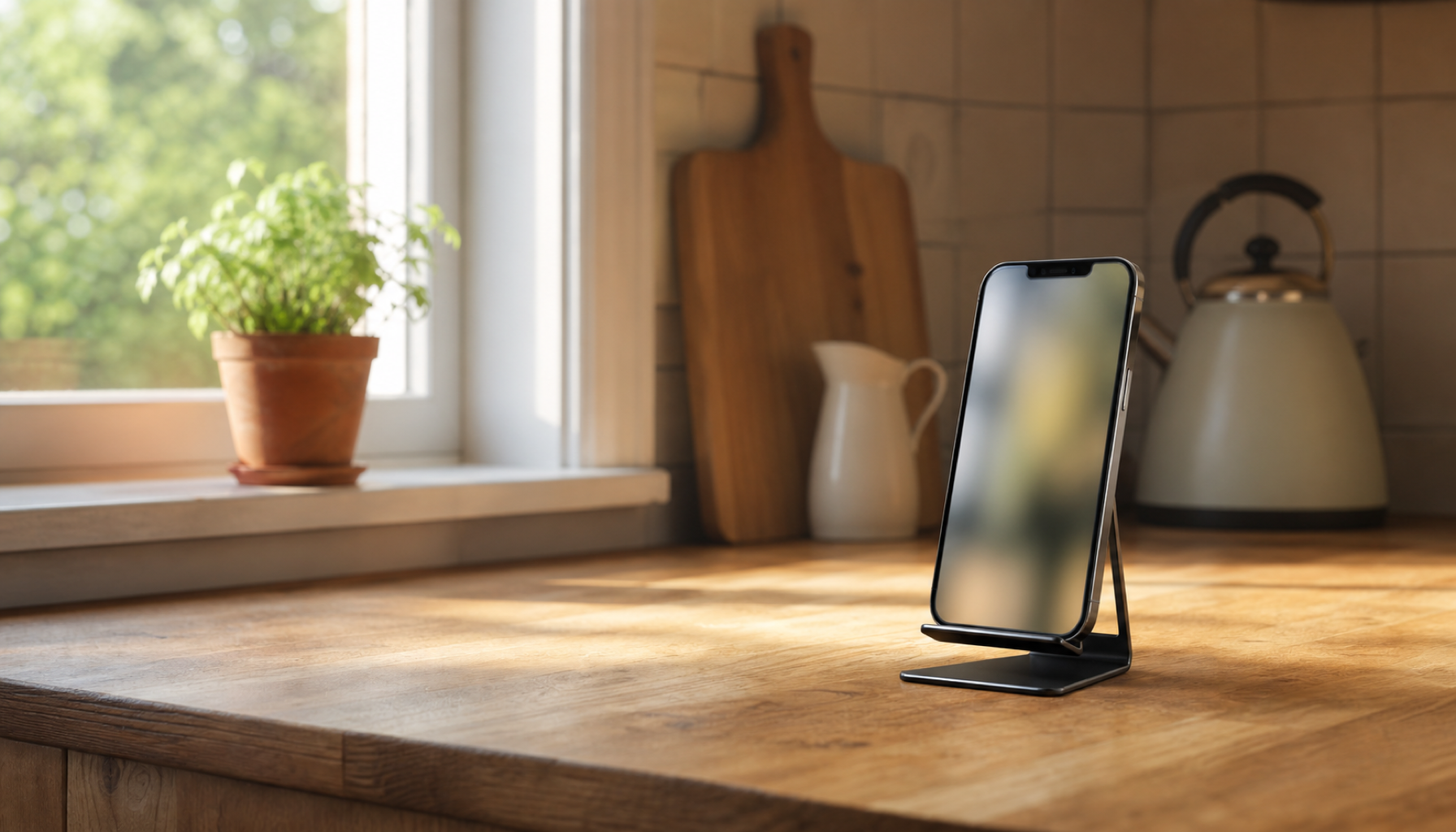
My phone lives on a stand in the kitchen. Not in my pocket, not on the arm of the sofa, not face-down beside me on my desk where I can still see it light up. It has one place, and that is where it stays most of the time. The small inconvenience of having to go and get it is exactly why I use it less.
People assume this is discipline. It is the opposite. I gave my phone a home because I know that if it is within reach, I will reach for it. Every time. So I took the decision out of my own hands.
Nothing important gets missed either. If something urgent comes through, I see it on my Apple Watch, or on the Mac I am already sitting at. Out of reach does not mean out of touch.
Willpower is the wrong tool for this job
Screens are not neutral for an ADHD or AuDHD brain. They are built to be difficult to put down, and they are very good at it.
Every notification, every scroll, every clip the algorithm lines up next is offering your brain exactly what it is already hunting for. Novelty. Stimulation. Colour. A small hit of something new. An ADHD or AuDHD brain is wired to chase that, so the pull is stronger for us than it is for most people.
That is not a character flaw. It is just what is happening. And it means that “I will just use more self-control” is a plan that fails by design, because you are asking the tired part of your brain to out-argue the part that wants the reward. The reward wins.
So the trick is not to try harder. It is to change the layout of your day so the phone is further away and harder to grab. Distance and design, not willpower.
Why the escape hatch matters in summer
The phone is an escape hatch. A dull moment, a hard feeling, a task you do not want to start, and your hand is already moving.
In summer that matters more, not less. The days are longer and looser. There is more unstructured time, and unstructured time is exactly where the scrolling creeps in and quietly fills every gap.
The cost is not the minutes. It is what does not happen. Your attention never gets a chance to reset. Your nervous system stays in a low hum of alert. Sleep takes longer to arrive because your brain had no wind-down before bed. You reach September more frayed than you started, wondering why the break did not feel like one.
A lighter-screens summer will not fix everything. But it can hand back a few real things. Deeper sleep. A calmer body. The ability to sit with one idea for more than three minutes.
Design the distance, do not rely on the moment
The stand works because it decides for me in advance. In the moment I am too tired, too bored, or too keen to argue myself into checking it. So I do not leave it to the moment.
This is how ADHD and AuDHD brains tend to change a habit best. You do not win the battle each time it comes up. You arrange things so the battle happens less often. If you understand how your own attention and follow-through actually work, you can build around it instead of fighting it, and the free ADHD Scrolling Quiz is a good place to start seeing your own pattern.
A few ways to build the distance in:
- Give the phone a home that is not on your body. A drawer, a shelf, a basket by the front door. Somewhere that takes a deliberate walk to reach. The few extra seconds are often enough for the urge to pass.
- Charge it overnight in another room. If it is not on the bedside table, it cannot be the last thing you see or the first thing you grab. Buy a cheap alarm clock so the phone loses its one honest excuse for being there.
- Turn off the notifications you did not choose. Every badge and buzz is an invitation you did not send yourself. Leave the ones that genuinely matter and switch off the rest, so the phone stops tapping you on the shoulder.
Swaps that give the escape hatch somewhere to go
Taking the phone away leaves a gap, and an ADHD or AuDHD brain does not sit well in a gap. So it helps to have something waiting in it.
- A paperback instead of a scroll. Not because reading is virtuous, but because it uses a different part of your brain. A novel gives you a story and forward pull without the unpredictable spikes. The library is free. Start there.
- One phone-free hour, same time each day. Pick the hour in advance so it becomes a habit, not a fresh decision each day. First thing in the morning works well, before the day starts pulling at you.
- Something to listen to rather than look at. Music or a podcast gives your brain the stimulation it is after, without a screen pulling your eyes back every few seconds. It also travels, so you can be walking, cooking or doing the washing up while it happens. You can connect your phone with bluetooth to a speaker, headphones or earbuds.
Try one thing, not the whole list
The pull when you read a list like this is to do all of it at once, starting tomorrow. That is the all-or-nothing setting an ADHD or AuDHD brain slips into so easily, and it is usually why nothing sticks.
Pick one. Give it a week. Notice what shifts, even a little. You are gathering information about your own brain, not sitting an exam, and there are no marks lost for changing your mind.
If a summer of this shows you that the harder pattern is your attention and follow-through across the board, not only your phone, that is worth taking seriously. It is the kind of thing working with a coach is built for: understanding how your particular brain works, then building a way of living that fits it.
FAQs
Why is it so hard to put my phone down when you have ADHD?
Screens are built to be difficult to put down, and they offer exactly what an ADHD or AuDHD brain is already hunting for: novelty, stimulation and a small hit of something new. The pull really is stronger for us than for most people. That is not a character flaw, it is how the brain responds to reward.
Does willpower work for cutting down screen time?
Not reliably. Trying harder asks the tired part of your brain to out-argue the part that wants the reward, and the reward usually wins. What works better is changing the layout of your day so the phone is further away and harder to reach. Distance and design, rather than self-control in the moment.
What is the best way to reduce phone use with an ADHD brain?
Give the phone a home that is not on your body, somewhere that takes a deliberate walk to reach. Charge it overnight in another room, with a cheap alarm clock so it has no excuse to be by the bed. Then turn off any notification you did not choose. Change one of those things, not all three.
Why does scrolling get worse in the summer?
The days are longer and looser, with more unstructured time, and unstructured time is exactly where scrolling creeps in and fills every gap. The cost is not really the minutes. It is that your attention never gets a chance to reset, so you arrive in September more frayed than you started.
Not sure how much your phone is really taking from your day?
Take the free ADHD Scrolling Quiz. A few short sections, and you will get your personal results for where scrolling fits in your day, plus practical starting points for what actually helps.
Considering 1:1 coaching?
If you are seriously thinking about coaching for yourself, a free Discovery session is a relaxed conversation on Zoom about what is going on for you, and whether working together is the right next step.
Book Your Free Discovery Session
Get the free guide, and join my weekly newsletter
Sign up and I will send you my free guide, 5 ADHD-Friendly Organisation Hacks (and how to make them stick), straight away. You will also join my weekly newsletter with practical strategies for adults with ADHD and AuDHD. Unsubscribe any time.

About Linda Fox
Linda is an ICF-ACC credentialled adult ADHD coach (ADHD Life & Business Coach, CALC), with lived experience of ADHD herself. She has been coaching adults with ADHD since 2000, one of the very first specialist ADHD coaches in the UK.
She works with entrepreneurs, legal and medical professionals, and others navigating demanding careers, helping them build practical strategies that fit how their brain actually works rather than fighting against it.
UK-based, supporting clients with ADHD and AuDHD worldwide on Zoom.